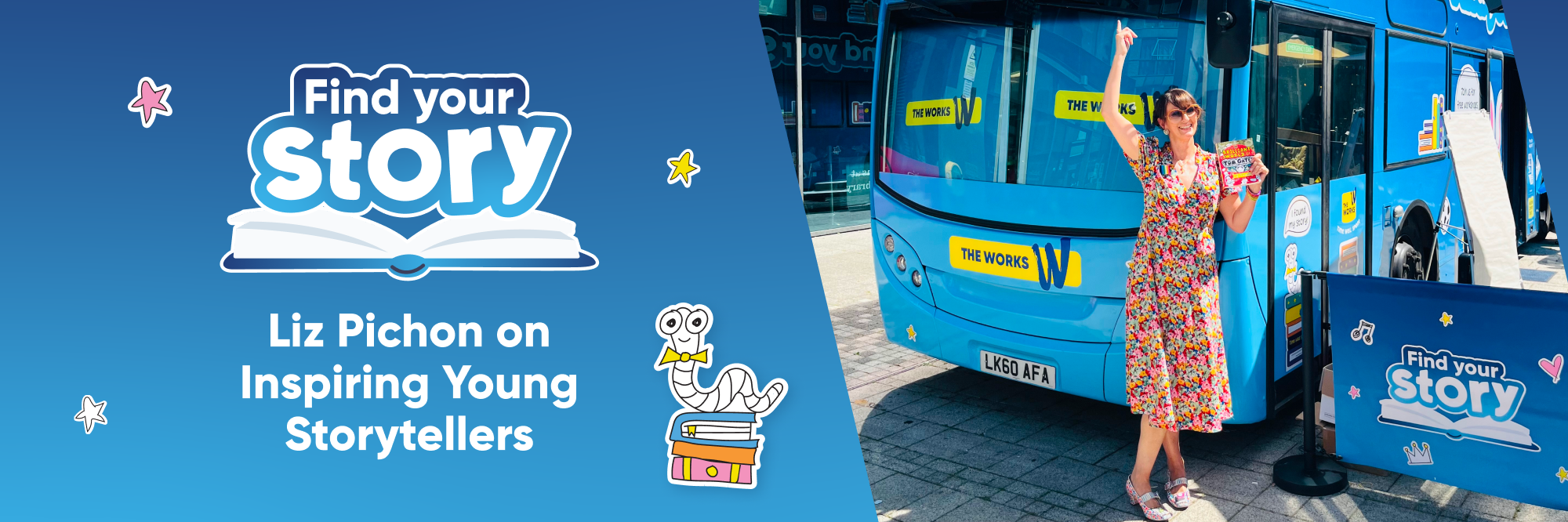
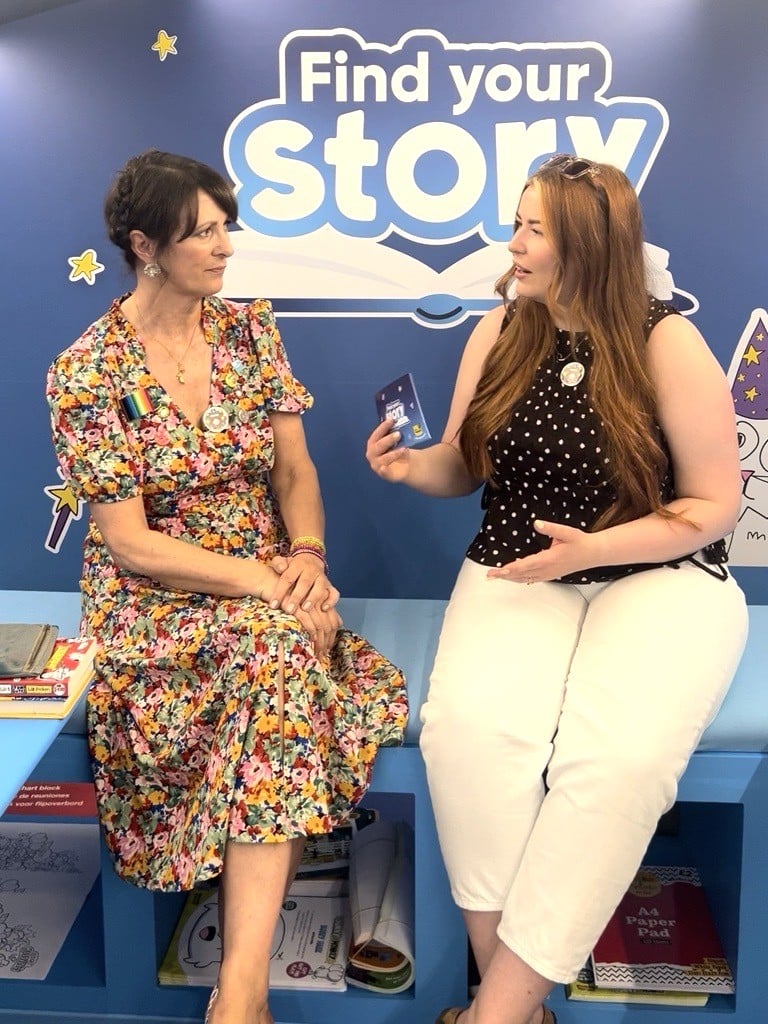
On the hottest day of the year (so far!) in Brighton, we climbed aboard the Find Your Story book bus — a bright, buzzing space filled with books, doodles, and inspiration — to sit down with the wonderful Liz Pichon, author and illustrator of the much‑loved Tom Gates series.
From the moment we settled in, Liz was full of stories: how Tom Gates might leap into the chalk‑drawn world of Mary Poppins, why music is such a big part of her creative process, and how a single doodle can spark an entire book. She spoke openly about being dyslexic — and how that shaped not only her confidence growing up but also the visual, energetic storytelling style that has helped so many children fall in love with reading. “I never thought I’d be an author… my spelling’s terrible, still is,” she told us, reflecting on how she didn’t start writing her own stories until her forties.
During our time together, we explored everything from encouraging reluctant readers (“Nothing puts you off reading more than reading something you don’t enjoy” ) to why picture‑heavy books deserve far more respect, to the importance of letting kids make mistakes, scribble freely and discover their own creative voice. And of course, we talked all things Tom Gates — the humour, the chaos, the relatable everyday moments, and the spark of imagination that keeps readers coming back.
What follows is a joyful conversation with an author who champions creativity in all its forms — and who believes every child has a story worth telling.
Liz Pichon Interview
If Tom Gates could jump into any other children's book world for the day, where would he cause the most chaos?
Do you know, I always think back to Mary Poppins, and that's partly watching the film of Mary Poppins as well, where they draw chalk pictures and then they jump into it. And I think Tom would cause a lot of chaos, being able to sort of draw pictures, and then sort of dive into it. I think that would be quite good.
What do you think he would draw?
Well, obviously lots of stars and doodles and maybe a monster, but he could be a friendly monster.
And if your drawing sessions had a soundtrack, what would be on it?
Well, I don't know if you know, but music is a really big part of the Tom Gates world. So Tom's in a band, DogZombies, and so my husband and I write all the songs. So all the songs that you hear in the TV show, we've written them. So it would probably be a DogZombies soundtrack, I think. Or maybe, we've got a song called School Dinner Blues and it's cool. Everyone just shouts out, "Chips, what do we want? What do you want? Chips, when do we want them?" Walking in the Park, that's another good one.
We're going to talk a little bit about creativity and illustrations as that's where you started. Do you ever begin with a doodle and let it lead your story rather than the other way around?
I never thought that I was a writer of a story. It never crossed my mind that I was ever going to do anything like this. I love drawing and making things, that was something I always did as a kid, but actually writing stories, although I loved writing stories, I never thought I'd be an author because I'm dyslexic, my spelling's terrible — still is — and it really just didn't ever occur to me that I'd be able to write stories.
I didn't start writing my own stories until I was in my mid 40s. Confidence, you know. So when you say where does it start? I started to think about writing my own stories because I was illustrating other people's stories. I used to do lots of greeting cards and album covers and I used to do illustrations that went on lots of different products and then publishers started to see my cats and dogs and thought, "Oh maybe she could illustrate this baby board book", so I got into writing stories through that: through illustrating other people's books. Then it really made me think I had stories, and I thought if I wrote my own stories then maybe I could illustrate them. And that's how I started.
So it is very much about doing a drawing, drawing a character. I once went to see a publisher really early on and I'd just done this image of a dog in the wind being blown literally at right angles with a tree hanging on. And I remember them saying to me, "Could you write a story to go with that picture? Because that would be quite a good image". So that obviously sparked off the idea.
Stories can come from everywhere. You never know where. It could be a drawing or doodle, it could be something that you hear or something that you read or something you see or something your friends tell you. You just never know where they're going to come from. So you have to just remember that, write them down.
Do you have a notebook with you wherever you go?
I try and take pictures. I try and write down doodles. I hear somebody's got a good name or I hear a conversation because you forget things. So I always say to children, this is a good tip: keep a diary, keep a notebook, write down things that your friends say, write down the ideas, cut things out that you like and stick them in a book. Collect things because those are the places that the stories can come from. You just never know. So that's a good tip there.
You've spoken about dyslexic thinking shaping your creativity. How has it influenced the way you design stories and the visuals for young readers?
I never set out to do a book fordyslexic kids or reluctant readers, you know, it wasn't in my thinking, but because of the books and things that I loved when I was younger, I think instinctively I wanted to put lots of drawings and pictures and doodles into my stories to help tell the story because those are the books that I really liked. And so that's what I wanted to do. All the books that I do, with the publishers, we always work really hard to make sure that every page is full of really interesting things that help to tell the story and we spend a long time like laying the pages out and working it out. It really has made a big difference, I don't think I would have thought in the same way if I wasn't dyslexic.
I'm always really keen to tell children that if they do find reading difficult or they are dyslexic, don't let it stop you from writing a story or doing something. Part of what I've done over the years is I've found a way to tell my stories and not everybody will do it in the same way, but it's really important that if you have stories to tell that you find a way of getting them out of your head and finding a way to do it. Using drawings and pictures and people is one way of doing it — and equally as important!
So, speaking of drawing, your books often encourage kids to draw along. So what's your favourite doodle prompt to give young readers if they wanted to start their own journal?
I mean, honestly, don't get nervous about a blank piece of paper. Just draw something. Especially if it's a really fancy book, people think, "Oh I can't", it doesn't matter. Just pick up a pen; just start. That's the hardest thing to do.
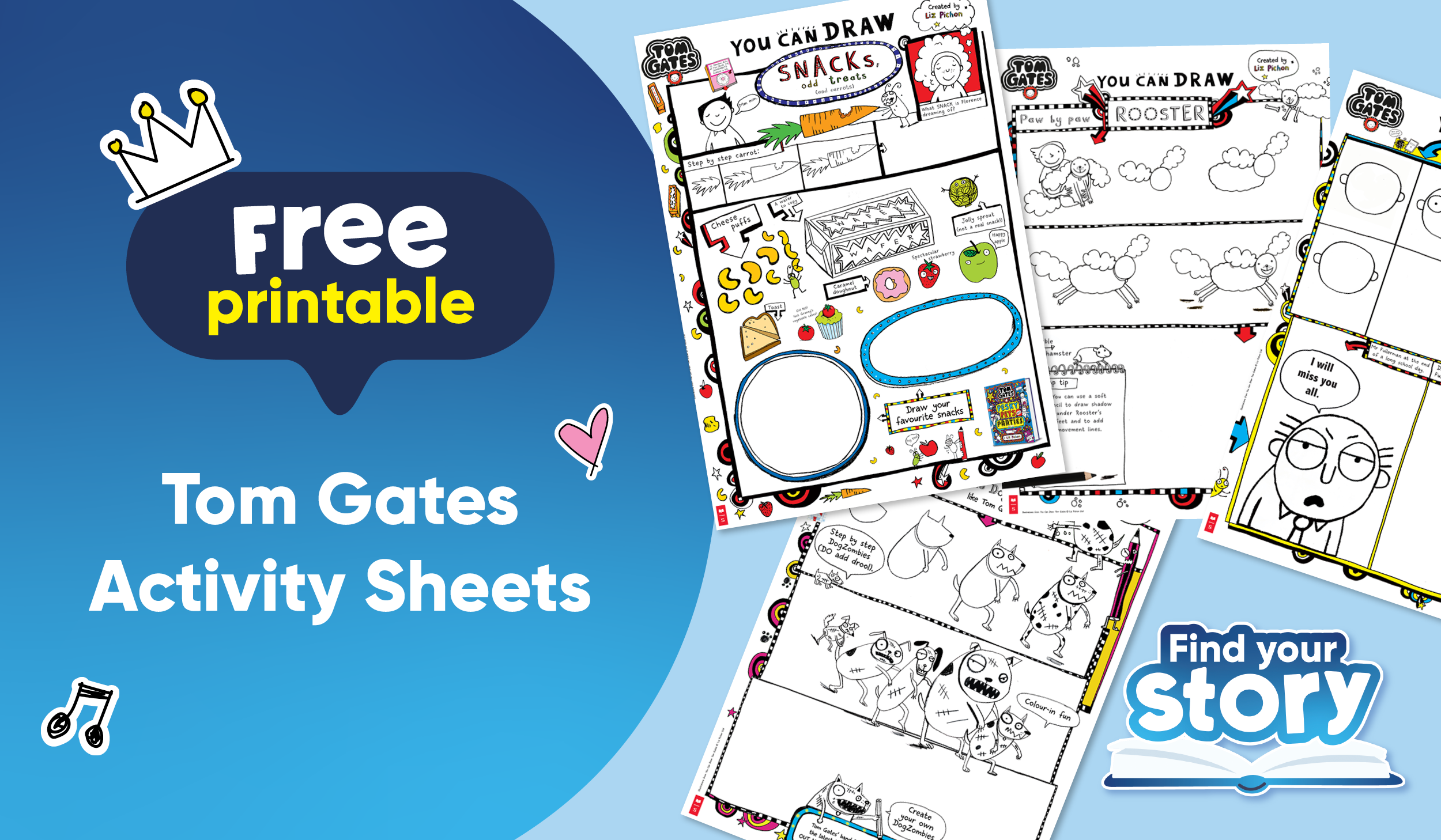
You don't need fancy equipment, just a pencil, a piece of paper, fold it in half, make your own little book. Keep scrapbooks, stick things in and that would be my prompt. Just start. Get your ideas down and just start writing because nobody writes brilliant stories first time. Nobody does. Part of the process of writing is actually editing, but you have to get it out and start somewhere.
Let's talk about reading confidence and finding your story as this is what our Find Your Story campaign is all about. So you've mentioned before that librarians were some of the first to use Tom Gates to encourage reluctant readers. For children who don't think they like reading yet, what's the one small step they can take to find a story that feels like theirs?
Nothing puts you off reading more than reading something that you don't enjoy. And let's face it, adults don't do it. You know, if you're reading a book and you're not enjoying it, you're not going to finish it. So it's really important to find something that you enjoy.
And librarians, big up to the librarians. Going into the library, having a look around, being able to choose a book that interests you, talk to librarians, you know, they will be able to point you in the direction of books that you might enjoy. So they were definitely a big part in the early days of showing kids saying, if you don't like reading, maybe you'll enjoy this book. So that's a big part of it. But I just think find something and don't worry about how long you read for either. It's just the process of picking something up and reading it, whether it's a comic, a graphic novel, or, like I said, or a book about a hobby or something.
Everyone loves a collection of books as well. Kids love collecting things. When they find a book they love, they get a little passionate about it. I was always reading things over and over again and going back and seeing what else you could discover about a book. So that's what's really exciting. This is brilliant [points to the Find Your Story sign on the bus]. So find your story, exactly. Find your story.
That's brilliant because that's the heart of our campaign. Obviously, if you love football, read about football. If you like graphic novels, read graphic novels, just anything that really sparks your interest.
Exactly. And also, you start off reading one thing and as you get older you might find other things as well. Audiobooks are really good as well. So I used to love it and my kids used to love it as well. We'd get a book and we might read it or they read it and if they're going to bed we'd put the photo book on. So they'd just be able to sort of sit in there and look at pages and have somebody else tell the story. And that's good for parents as well who might not feel confident in reading.
As we've discussed, picture heavy books are sometimes dismissed as being easier. What do you wish adults understood about how visual storytelling builds real reading confidence?
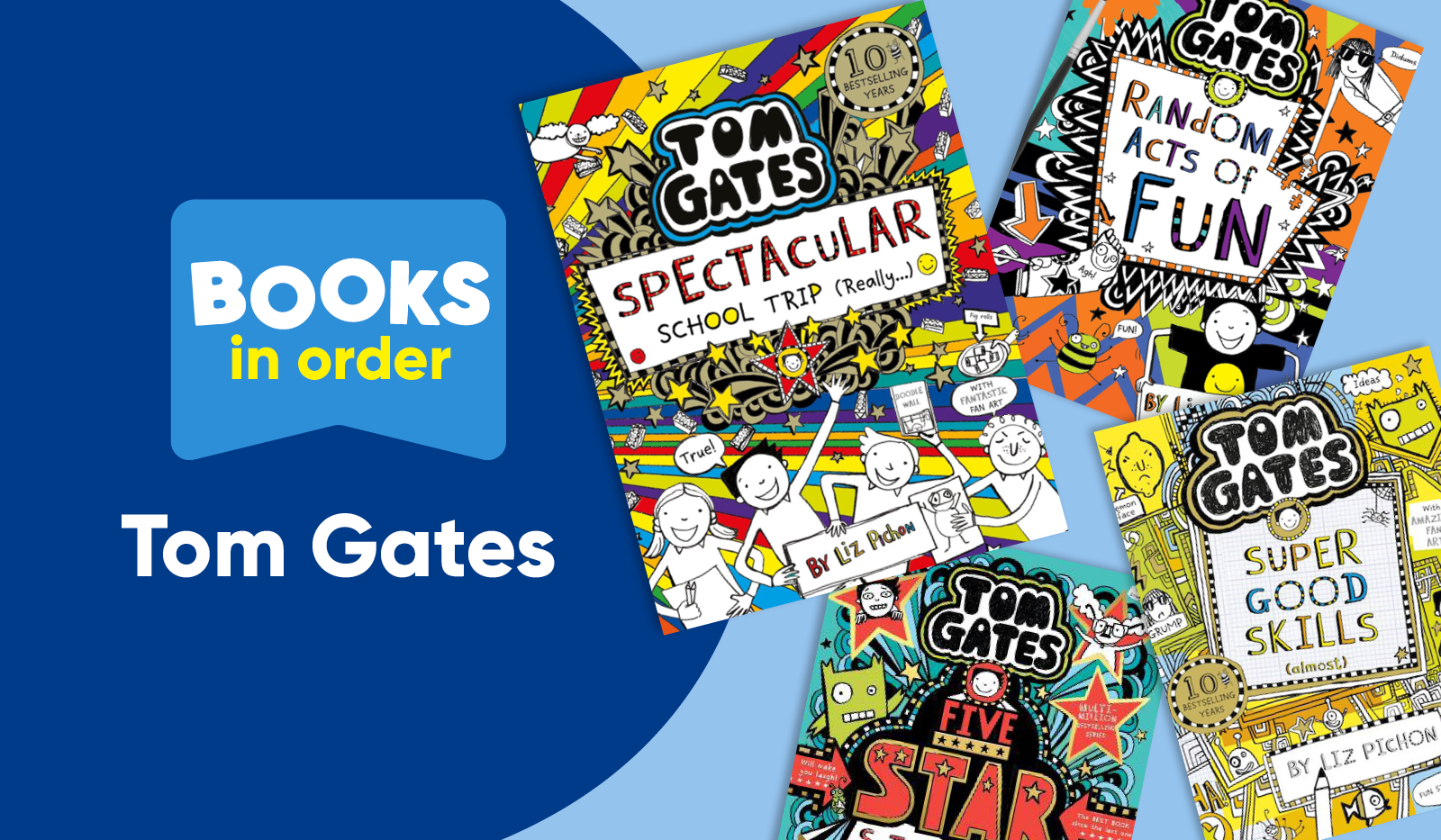
Well, you can see my books have got [Liz shows the first Tom Gates book] honestly, these have got, this is about 16- 17,000 words. And actually, the latest book, that will come out in October, usually about 19,000 words or something. Every single page is kind of crafted to help you, so that your eye follows it along. I don't think adults realise, when they pick something up, they can dismiss the pictures as being "not proper text".
I loved books with pictures and illustrations and some parents don't realise that the illustrations, great illustrators, will tell another story within the illustrations. So you'll be able to read the text and then the pictures will tell you a completely different story. And that's part of the whole book, you know, like where the font is, how big the text is. All of that goes together to how to tell a story. There's loads of thought and care and attention that goes into that. So parents, don't worry if your kids are reading graphic novels or comics, that's all reading. I know so many authors and illustrators who are fantastic writers, who all grew up loving comics and went on to write fantastic books. Comics and pictures, they help spark children's imagination and gets them excited about it. So that's something that I would say to parents. Don't worry about feeling like it's not a proper book.
Many kids feel pressure to get things right. What would you say to a child who loves drawing or writing but worries they're not good enough?
Honestly, it's really difficult and I think particularly children these days feel like they can't fail. You know, there's pressure that they can't. And actually, doing things, making mistakes, is how you learn. It's so important that you just try things out. You know, you try out different art materials or paint, you find, you can discover what you enjoy and sometimes it's just as important to find out the things that you don't like as the things that you do like. That's part of learning so it's really important and I always say to kids that don't worry about making a mistake.
Even now I have author and illustrator friends, illustrator friends that are amazing at drawing and I would never be able to draw like them in a million years but everybody has their own way of doing things. You can appreciate what somebody does and being confident about what you're doing and enjoying it, that really comes across. We need the next generation of storytellers. It's so important that those children understand that they have stories to tell and the only way that's going to happen is if they do it and not worry about making mistakes.
Honestly, I've written picture books and stuff that haven't ever seen the inside of a bookshop. And you know, you look back at some of the stuff you did in the early days and you think, oh, I could make changes or things like that. But it's just really important to just keep going.
Yeah, it's a journey isn't it. You've seen where you started and where you are now, and our differences make us unique.
Absolutely. So just try things out. Don't be frightened. Don't be frightened of failing because actually that's all part of the process of learning how to do something and enjoying it as well, which is really important.
If you're not enjoying writing the story, then the chances are somebody is not going to enjoy reading it. So it's really important that you write things that you are interested in or that you enjoy. If you're going, I'm not really enjoying this, then put it to one side. I mean, Tom Gates took me about two years. I'd never written anything more than a picture book. And it took quite a while just to sort of make it into a story and work out what the characters were. Sometimes you get an idea and you just park it to one side and then you might go back to it later. So just because something isn't working right at that moment, it doesn't mean to say that it's a terrible idea.
You've said readers' imaginations are just as important as your own. How do you design stories that leave room for kids to add their own stories?
Well, Tom Gates is now translated into about 47 different languages and territories. So it's amazing to me that children all over the world are reading the books and relating to them. And I think one of the things that I was really keen to do was to write things that, it doesn't matter where you were, it doesn't matter what country you were in, that they would feel like it was relatable and they would think about parents, about their friends, pets, all of that sort of stuff. So I think that's, for me anyway, writing the Tom Gates books is always trying to think about things that are relatable. that kids can pick it up and they think, Oh, that's like me, or, My sister's like that, or, Oh, I remember going shoe shopping, you know, or going to the hairdresser's or going to the dentist. So it's those things that are similar in childhood that some things never change, I think. Those are the things I like. I don't tend to write about big adventures, although there are the occasional adventure that creeps into the books, but I like writing about the sort of small quote details that lots of children can relate to.
If you could leave every young reader and doodler with one message about finding their story, what would it be?
Pick up a book. Find something that you're interested in and get into the habit of reading a little bit. Don't get put off. Libraries are great places to go because there's no pressure on you. You can discover books that aren't out now, from the past, and just find something that you absolutely love that inspires you to write your own stories.
Keep a diary as well. Part of the fun thing about keeping a diary is that when you get older, you get a chance — like me — to look back and reminisce. Get your friends to write little notes and keep things like that. Be a collector because even if you never end up being an author, you'll always look back on that and it'll be something really precious to you. And it's a way to get your emotions, thoughts, and feelings out of your head.
© Liz Pichon 2026