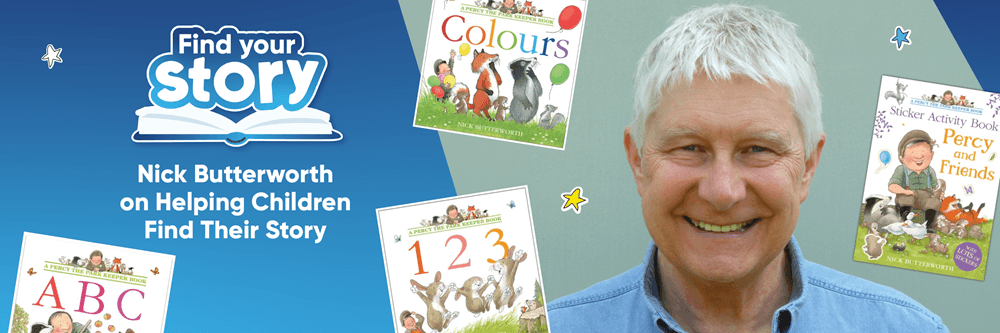
There are some children’s books that feel like old friends — stories you return to again and again because they’re filled with warmth, wonder and that gentle kind of magic only the very best authors can create. Nick Butterworth is one of those rare storytellers. From Percy the Park Keeper to One Snowy Night, his books have been part of bedtime routines, classroom corners and family memories for decades.
As part of our Find Your Story campaign, we wanted to sit down with Nick to talk about something close to every parent’s heart: how to nurture a love of reading. Because while every child’s reading journey is different, one thing remains the same: stories have the power to spark curiosity, build confidence and help children discover who they are.
In this conversation, Nick shares his thoughts on why reading matters, how parents can encourage even the most reluctant readers, and why letting children follow their interests is one of the most powerful things we can do. His insights are thoughtful, reassuring and full of the same warmth that fills his books.
Nick Butterworth: Tips for Parents from a Beloved Author
Why do you think stories are such an important part of childhood?
Stories are important for everyone. I don’t just mean stories in books. Stories come to us in all sorts of ways; some written, some performed, some verbal. Sometimes we don’t recognise them as stories, but a spontaneous account of what just happened in the street, is as much story telling as someone recalling an exciting adventure from years ago.
Reading is only one way to benefit from stories. But I would add, a really good way!
For adults and children, stories help us to make sense of a very complicated world. Stories present scenarios in bite-size chunks that are easier to digest.
Stories, by the power of imagination, can take us to places we wouldn’t otherwise be able to go. And not just far-flung places, but time-travel too, taking us back into history or forward to possible futures. Stories can inform, warn, entertain and inspire.
Children’s imaginations are stimulated by stories. Reactions like, “Wow! That would be great!” or “How could she do that?” or “Are there really dinosaurs in Dagenham?” show how stories get their juices flowing. Children’ will often enact their own version of a story that has engaged them, giving their imaginations a thorough workout, as cardboard boxes become castles and cuddly toys become players in heroic scenes.
Stories also help to shape a moral framework. In stories we encounter heightened moral dilemmas that ask questions about right and wrong. Actually, I’m not a big fan of stories that are primarily about morality. As a boy, I found Aesop’s fables very unsatisfying. But a story teller’s perspective, will always be detectable in their story. Their values will out, and I confess, I have not been able to hide my own. I think the trick is to bury them deeply in the narrative. Preachiness is always unpalatable.
What first sparked your own love of storytelling, and how has that shaped the way you create books today?
I was extremely lucky to have two wonderful women in my young life. My mum and her mum, my granny, endlessly read stories to me, as well as telling me stories from their own lives. Because I didn’t take easily to reading for myself, my mum continued to read to me for longer than is often the case, and so the kind of books we read evolved from stories such as Beatrix Potter’s Tale of Samuel Whiskers, to Alice in Wonderland, Tom Brown’s School Days and Moby Dick. As the stories became longer and more engaging, I hardly noticed that so were the words. Though I found reading difficult, I developed a love of language. I can still hear, in my mind, my mum’s voice as she read from one of the Just So Stories, “Go to the banks of the great, grey-green, greasy, Limpopo River, all set about with fever-trees, and find out…”
Where do the ideas for your stories come from, and how do you keep your imagination so alive?
I just love stories. It’s probably for that reason, the things I see, hear, read about – almost anything – can become a candidate for a story, or at least a piece of a story. Occasionally, something in particular gets to me. It could be funny, disturbing, or inspiring. I don’t usually think, ‘I’m going to write a story about that’. It’s rather that the germ of something starts to take root. There’s a sort of gestation period where an idea begins to take shape. I never want to talk about ideas at this early stage. At this point things can go in a hundred different directions, and I don’t want other influences to shut down possibilities. What happens in a story, commonly called ‘the story arc’ is paramount. But a story has to pass muster visually too. I love the early development stage where I play with ideas and decide the course of a story. Then it becomes a matter of what will be conveyed in words and what the illustrations will contribute.
I never run out of ideas. It takes a long time from initial idea to finished book, and during that time, other ideas come to me. It can be frustrating when a new, exciting idea comes to me, and I’m just not free to pursue it at the time! I keep a note of things that I think have potential. Sometimes they eventually emerge as a new front runner.
When you’re creating a book, what do you think about in terms of what will engage or delight a child?
I seem to be able to remember, perhaps better than some, how I felt as a child. What made me laugh. What worried me. What was important. In a way, when I’m creating a story, I’m making it for the child I was. I play with ideas. Sometimes, in that playful mode I can be delighted or find something hugely funny. I can also be quite moved sometimes.
When I first began to write, I had no idea whether my efforts would hit the spot for children. I did no research, except to show some early writing to a teacher friend. She told me that the vocabulary was a bit advanced for the age group! I adjusted accordingly. It’s still important to me to be open to constructive criticism. I don’t want to be like the preacher who, in his pulpit, was said to be ‘six foot above contradiction’!
Our Find Your Story campaign is all about letting children choose what they read. Why do you think following a child’s interests matters?
It’s because we’re all different, with different personalities, interests, experience, and particularly for children, levels of understanding. I don’t persist with reading a story that doesn’t grab me (unlike my wife, who can get to the last chapter of a book, hoping it’s going to improve!) As a boy, it was Treasure Island that got me hooked on reading for myself. The story pulled me in. I so wanted to know what happened next, it got me over my reluctance to read. Things got better from there.
Many parents want to encourage reading but aren’t sure where to start. What simple things can they do at home to spark a love of books?
The best way, by far, is to make the time to read with children. Share the story. Make it part of family life that you spend time enjoying stories together. Cajoling childen to read, or even encouraging them from the sidelines, will simply not work. Reading itself is not the enjoyable thing. It’s the stories that reading unlocks.
Do you have any tips for reading aloud — especially to children who find it hard to sit still?
There’s no right or wrong way to share stories. It helps if the Champions’ League or Eastenders aren't blaring away in the background.
Don’t get impatient with fidgety children. Engage them with a lively book that they can take part in. Every time the lion or the dragon or the mouse appears, let them roar or squeak. Maybe the lion has a dance he likes to perform? Discuss his family (make one up if he doesn’t have one) or why he has a stripey shirt.
Children like a favourite story over and over again. Make a favourite one your own by adding little things that you do when certain things happen or before you turn over a particular page. These are the things that childhood memories are made of – treasured little moments of shared fun with someone they love, remembered years later in adulthood. “Do you remember the creaky door sound, when the giant appeared?!” “Can you still do the Unicorn dance?!” “Why did the Tiger have a Brummie accent?!”
What would you say to a child who feels unsure about reading or worries they’re “not good at it”?
I wouldn’t begin with the child. Let the grown-up take the lead and gradually let the child read little pieces of the story. Look for certain words. Pause every time a repeated word appears – ‘crocodile’, ‘birthday’, ‘Gruffalo’, and let them fill in the blank. Gradually let them have more to read. Confidence breeds more confidence. Above all, keep it light. This isn’t a chore.
What role do you think illustrations play in helping children connect with a story?
To begin with, pictures are much more interesting to look at than a page of small, black squiggles. Children, who are unfamiliar with books, don’t at first realise that the storyteller is accessing the story from these squiggles. When it becomes apparent, it can be a revelation! Illustrations can help a young reader to make intelligent guesses about the words in front of them. This isn’t cheating. We all use whatever cues we can to fill in the blanks in everyday life! Familiarity turns the guesswork into knowledge. It becomes clear that a particular collection of letters does mean ‘squirrel’ – even if there’s no squirrel in the picture.
Pictures can, of course, contribute something of their own to a narrative – something not necessarily referred to in the text. A facial expression (perhaps from a minor character) or even a secondary narrative altogether, a running joke that continues from page to page. Atmosphere and mood are more examples of how illustrations can make a significant contribution.
From a writer’s perspective, the old saying, one picture is worth a thousand words, has a lot of truth to it, and is especially pertinent when word count is limited by format. It could be a waste of precious words to say, “He put on his red coat and left the house…” if the red coat is there to be seen in the picture.
What do you hope children feel when they read your books?
What a good question! As much as possible, I’d say. A good tale can be like a workout for our emotions. We can experience happiness, sadness, fear, anger and elation as we enter into the world of imagination. And the bonus there is that, as we do, it’s not just what our own feelings that are involved. When we engage with a story, we feel what the characters in the story feel. We feel sad or angry if they’re treated unfairly. We feel pleased for them when things turn out well. We are exercising our ability to empathise with others.
Teachers have spoken to me about a lack of empathy in children who have had little contact with other children. They need to learn to appreciate how other human beings feel and how we can affect one another’s feelings.
If you could leave parents with one piece of encouragement about sharing stories with their children, what would it be?
Oh dear – only one?
Do it, if you’re not doing it already! Don’t delay. The short period in children’s lives where you’ll have this golden opportunity will be over before you know it.
The benefits are huge. First of all, you’ll have great fun. And without trying at all, your child will grow in literacy, vocabulary and the confidence of self-expression. I’d add a note here to encourage parents to tell ‘their own story’. What were they like as children? What did they enjoy doing? Who was in their lives, at school, sport, hobbies, holidays. Young children will want to know and they will gain a deeper sense of their own identity from knowing where they’ve come from.
But there’s even more…
All the time you are reaping these benefits, you’ll also be storing up memories for the future, and building a close relationship that will better stand the test when the time comes (as it must) for children to become independent. Such times can be fraught, and relationships between parents and children can be stretched to breaking point over a thousand and one different issues.
If, underneath the stormy surface, there is a depth of relationship that is based on love and not agreement, it will stand a much better chance of holding fast when tested. When Spike Milligan was asked what his greatest achievement was, he replied, “that my children have become my friends.”
I have to say, I agree.
© Nick Butterworth 2026